Dr. Martin Luther King, Jr.'s "I Have a Dream" Speech
August 28, 1963
(Section 1)
I am happy to join with you today in what will go down in history as the greatest demonstration for freedom in the history of our nation.
Five score years ago, a great American, in whose symbolic shadow we stand today, signed the Emancipation Proclamation. This momentous decree came as a great beacon light of hope to millions of Negro slaves who had been seared in the flames of withering injustice. It came as a joyous daybreak to end the long night of their captivity.
But one hundred years later, the Negro still is not free. One hundred years later, the life of the Negro is still sadly crippled by the manacles of segregation and the chains of discrimination. One hundred years later, the Negro lives on a lonely island of poverty in the midst of a vast ocean of material prosperity. One hundred years later, the Negro is still languished in the corners of American society and finds himself an exile in his own land. And so we've come here today to dramatize a shameful condition.
In a sense we've come to our nation's capital to cash a check. When the architects of our republic wrote the magnificent words of the Constitution and the Declaration of Independence, they were signing a promissory note to which every American was to fall heir. This note was a promise that all men, yes, black men as well as white men, would be guaranteed the "unalienable Rights" of "Life, Liberty and the pursuit of Happiness." It is obvious today that America has defaulted on this promissory note, insofar as her citizens of color are concerned. Instead of honoring this sacred obligation, America has given the Negro people a bad check, a check which has come back marked "insufficient funds."
But we refuse to believe that the bank of justice is bankrupt. We refuse to believe that there are insufficient funds in the great vaults of opportunity of this nation. And so, we've come to cash this check, a check that will give us upon demand the riches of freedom and the security of justice.
We have also come to this hallowed spot to remind America of the fierce urgency of Now. This is no time to engage in the luxury of cooling off or to take the tranquilizing drug of gradualism. Now is the time to make real the promises of democracy. Now is the time to rise from the dark and desolate valley of segregation to the sunlit path of racial justice. Now is the time to lift our nation from the quicksands of racial injustice to the solid rock of brotherhood. Now is the time to make justice a reality for all of God's children.
It would be fatal for the nation to overlook the urgency of the moment. This sweltering summer of the Negro's legitimate discontent will not pass until there is an invigorating autumn of freedom and equality. Nineteen sixty-three is not an end, but a beginning. And those who hope that the Negro needed to blow off steam and will now be content will have a rude awakening if the nation returns to business as usual. And there will be neither rest nor tranquility in America until the Negro is granted his citizenship rights. The whirlwinds of revolt will continue to shake the foundations of our nation until the bright day of justice emerges.
(Section 2)
But there is something that I must say to my people, who stand on the warm threshold which leads into the palace of justice: In the process of gaining our rightful place, we must not be guilty of wrongful deeds. Let us not seek to satisfy our thirst for freedom by drinking from the cup of bitterness and hatred. We must forever conduct our struggle on the high plane of dignity and discipline. We must not allow our creative protest to degenerate into physical violence. Again and again, we must rise to the majestic heights of meeting physical force with soul force.
The marvelous new militancy which has engulfed the Negro community must not lead us to a distrust of all white people, for many of our white brothers, as evidenced by their presence here today, have come to realize that their destiny is tied up with our destiny. And they have come to realize that their freedom is inextricably bound to our freedom.
We cannot walk alone.
And as we walk, we must make the pledge that we shall always march ahead.
We cannot turn back.
There are those who are asking the devotees of civil rights, "When will you be satisfied?" We can never be satisfied as long as the Negro is the victim of the unspeakable horrors of police brutality. We can never be satisfied as long as our bodies, heavy with the fatigue of travel, cannot gain lodging in the motels of the highways and the hotels of the cities. *We cannot be satisfied as long as the negro's basic mobility is from a smaller ghetto to a larger one. We can never be satisfied as long as our children are stripped of their self-hood and robbed of their dignity by a sign stating: "For Whites Only."* We cannot be satisfied as long as a Negro in Mississippi cannot vote and a Negro in New York believes he has nothing for which to vote. No, no, we are not satisfied, and we will not be satisfied until "justice rolls down like waters, and righteousness like a mighty stream."
I am not unmindful that some of you have come here out of great trials and tribulations. Some of you have come fresh from narrow jail cells. And some of you have come from areas where your quest -- quest for freedom left you battered by the storms of persecution and staggered by the winds of police brutality. You have been the veterans of creative suffering. Caontinue to work with the faith that unearned suffering is redemptive. Go back to Mississippi, go back to Alabama, go back to South Carolina, go back to Georgia, go back to Louisiana, go back to the slums and ghettos of our northern cities, knowing that somehow this situation can and will be changed.
(Section 3)
Let us not wallow in the valley of despair, I say to you today, my friends.
And so even though we face the difficulties of today and tomorrow, I still have a dream. It is a dream deeply rooted in the American dream.
I have a dream that one day this nation will rise up and live out the true meaning of its creed: "We hold these truths to be self-evident, that all men are created equal."
I have a dream that one day on the red hills of Georgia, the sons of former slaves and the sons of former slave owners will be able to sit down together at the table of brotherhood.
I have a dream that one day even the Istate of Mississippi, a state sweltering with the heat of injustice, sweltering with the heat of oppression, will be transformed into an oasis of freedom and justice.
I have a dream that my four little children will one day live in a nation where they will not be judged by the color of their skin but by the content of their character.
I have a dream today!
I have a dream that one day, down in Alabama, with its vicious racists, with its governor having his lips dripping with the words of "interposition" and "nullification" -- one day right there in Alabama little black boys and black girls will be able to join hands with little white boys and white girls as sisters and brothers.
I have a dream today!
I have a dream that one day every valley shall be exalted, and every hill and mountain shall be made low, the rough places will be made plain, and the crooked places will be made straight; "and the glory of the Lord shall be revealed and all flesh shall see it together."
(Section 4)
This is our hope, and this is the faith that I go back to the South with.
With this faith, we will be able to hew out of the mountain of despair a stone of hope. With this faith, we will be able to transform the jangling discords of our nation into a beautiful symphony of brotherhood. With this faith, we will be able to work together, to pray together, to struggle together, to go to jail together, to stand up for freedom together, knowing that we will be free one day.
And this will be the day -- this will be the day when all of God's children will be able to sing with new meaning:
My country 'tis of thee, sweet land of liberty, of thee I sing.
Land where my fathers died, land of the Pilgrim's pride,
From every mountainside, let freedom ring!
And if America is to be a great nation, this must become true.
And so let freedom ring from the prodigious hilltops of New Hampshire.
Let freedom ring from the mighty mountains of New York.
Let freedom ring from the heightening Alleghenies of Pennsylvania.
Let freedom ring from the snow-capped Rockies of Colorado.
Let freedom ring from the curvaceous slopes of California.
But not only that:
Let freedom ring from Stone Mountain of Georgia.
Let freedom ring from Lookout Mountain of Tennessee.
Let freedom ring from every hill and molehill of Mississippi.
From every mountainside, let freedom ring.
And when this happens, when we allow freedom ring, when we let it ring from every village and every hamlet, from every state and every city, we will be able to speed up that day when all of God's children, black men and white men, Jews and Gentiles, Protestants and Catholics, will be able to join hands and sing in the words of the old Negro spiritual:
Free at last! Free at last!
Thank God Almighty, we are free at last!
Monday (in class)
Watch the speech on-line. Research a little bit about who Dr. Martin Luther King was and what he accomplished
Tuesday
Read the first section of this speech.
1. Who is the “great American”? Related to that, where does this speech take place?
2. What does “five score years” mean? What one word is a synonym for this?
3. What metaphors are used to describe the problems that Negro Americans faced?
4. What three national documents are mentioned on this page, and why are they capitalized?
5. What is a promissory note, and what does it symbolize here?
6. What phrase (four words) is repeated in the paragraph which starts “It would be fatal…” What one word in the first line of that paragraph sums up this sentiment?
Wednesday
Read the second section of this speech.
1. That first section ended with a stern warning to those in power that they can’t put off change any longer. This next section starts with an admonition to those who have been oppressed. List at least 3 positive words to show what kind of protest King is encouraging, and at least 3 negative words to show what he wants to avoid.
2. “They have come to realize that their freedom is inextricably bound to our freedom.” What to does “inextricably” mean?
3. List at least four specific injustices, listed in this speech, that Negroes faced then.
4. Copy the sentence on this page which refers to Amos 5:24.
Thursday
Read the third section of this speech.
1. Copy the sentence in this section which is from the Declaration of Independence.
2. This is the section where the phrase “I have a dream” is repeated. How many times? Summarize what it is that King dreams.
3. What does King want his children to be judged for?
4. Copy the sentence in this section page which refers to Isaiah 40:4.
Friday
Read the fourth section of this speech.
1. What are two key words in the first paragraph of this section? Hint: Each one is repeated several times, and each one gives a clue to how King’s goals will come about.
2. Copy the sentence that refers to music. Why does King use this word picture?
3. King refers to geological features several times. List the proper nouns that refer to this, and then list the common nouns.
4. The phrase “Let freedom ring” is repeated for emphasis. What word, found in the quoted verse of the song “America”, is a synonym for freedom?
5. In the last lines of his speech, King quotes a Negro spiritual song, "Free at Last."
http://www.negrospirituals.com/news-song/free_at_last_from.htm
Free at last, free at last
I thank God I'm free at last
Free at last, free at last
I thank God I'm free at last
Way down yonder in the graveyard walk
I thank God I'm free at last
Me and my Jesus going to meet and talk
I thank God I'm free at last
On my knees when the light pass'd by
I thank God I'm free at last
Tho't my soul would rise and fly
I thank God I'm free at last
Some of these mornings, bright and fair
I thank God I'm free at last
Goin' meet King Jesus in the air
I thank God I'm free at last
Sunday, January 17, 2010

Tuesday, January 5, 2010
The Art of Albrecht Dürer
Albrecht Dürer
1471 - 1528
Self-Portrait in Fur Coat
1500
Oil on panel, 67 x 49 cm
Alte Pinakothek, Munich

Self Portrait at 26
1498
Oil on panel, 52 x 41 cm
Museo Nacional del Prado, Madrid

Christ Among the Doctors
1506
Oil on panel, 65 x 80 cm
Fundacion Coleccion Thyssen-Bornemisza, Madrid

St Peter And St John Healing The Cripple
1513
Engraving, 118 x 74 mm
Metropolitan Museum of Art, New York

Hands of the Apostle
1508, Sketch

A Young Hare
1502
Watercolor and gouache on paper, 25 x 23 cm
Graphische Sammlung Albertina, Vienna

The Last Supper
1523; Wood Block: 21 x 30 cm
Museum of Fine Arts in Boston

Writing Assignment #1: Choose one of these pictures (other than the two self portraits) and write a descriptive paragraph. Include a topic sentence, at least three sentences containing supporting details, and a conclusion sentence. The topic sentence may contain the information supplied above each painting, such as when it was created, what kind of art it is, or what museum now owns it. The three supporting detail sentences need to be your own observations about what is in the painting. The conclusion should include your opinion about the piece.
Writing Assignment #2: Write a paragraph that compares the two self portraits. The topic sentence will identify both paintings and make a statement of your opinion or observation about them. The three supporting detail sentences will explain your topic sentence with specific examples. The conclusion will restate your opinion in different words.
Thursday, December 3, 2009
Baby Jesus at the National Gallery of Art
Just some Christmas art for you to feast your eyes on -- while you scroll down for your real assignments!
 "The Adoration of the Shepherds" by Giorgione, 1505-1510

 "Madonna and Child" by Circle of Giovanni di Turino 1430, painted and gilded terracotta
 "The Adoration of the Shepherds" by Giorgione, 1505-1510
"The Adoration of the Magi" by Benvenuto di Giovanni in 1470-1475
 "Madonna and Child" by Circle of Giovanni di Turino 1430, painted and gilded terracotta

The Life of Christ fresco paintings by Giotto
These seven paintings by Giotto (1267-1337) are just part of the series of frescoes found in the Scrovegni Chapel in Padua, Italy. I found them on-line at http://www.wga.hu/. The painting titles are in bold print above each picture.
The Visitation

The Birth of Jesus

Presentation at the Temple

Adoration of the Magi

The Flight into Egypt

The Massacre of the Innocents

Christ Among the Doctors

The Visitation

The Birth of Jesus

Presentation at the Temple
Adoration of the Magi

The Flight into Egypt

The Massacre of the Innocents

Christ Among the Doctors

Tuesday, December 1, 2009
Music from Handel's Messiah
Watch these videos during the December 7-11 homework week.
Tuesday
"Behold, A Virgin Shall Conceive" and "O Thou That Tellest Good Tidings to Zion" are from Isaiah 7:14, Matthew 1:12, Isaiah 40:9, and Isaiah 60:1. Both of them are in this one video.
"Comfort Ye, Comfort Ye My People" is a recitative from Handel's Messiah. It is from Isaiah 40:1-3. "Ev'ry Valley Shall Be Exalted" is an air based on Isaiah 40:4. These are the first vocal pieces in The Messiah.
Wednesday
"For Unto Us a Child is Born" is a chorus in Handel's Messiah. It comes from Isaiah 9:6.
"The Hallelujah Chorus" is the best known section of Handel's Messiah. The audience always stands when this is sung, because the King of England did this when he attended a performance, and he set the precedent. This words to this song are from Revelation 19:6, Revelation 11:15, and Revelation 19:16.
Sunday, October 25, 2009
Wednesday, September 23, 2009
The Story of Esther Ahn Kim
Dear friends,
In 2007 and 2009, our Providence Home Educators 7th-8th grade English class did a literature study on the Biblical book of Esther. In conjunction with this, I told them the story of a young Korean woman named Esther Ahn Kim who defied Japanese idol worship in 1939 and courageously endured the consequences. The audio presentation below, recorded during class in September 2007, is a little over 11 minutes long.
In 2007 and 2009, our Providence Home Educators 7th-8th grade English class did a literature study on the Biblical book of Esther. In conjunction with this, I told them the story of a young Korean woman named Esther Ahn Kim who defied Japanese idol worship in 1939 and courageously endured the consequences. The audio presentation below, recorded during class in September 2007, is a little over 11 minutes long.
Wednesday, September 9, 2009
Paintings about the Story of Daniel
These six drawings and paintings are from the Biblical story of Daniel. They are part of a literature assignment for the 7th-8th Grade English class in the school week of September 14-18, 2009. Write a sentence for each of the five paintings telling some details that you notice.
 Nebuchadnezzar, King of Babylon, Selects Several Youths to Learn Babylonian Ways by Stemler
 Daniel Refuses to Eat the King's Delicacies The illustration is found in "Standard Bible Story Readers, Book Three and Four" by Lillie A. Faris, published by The Standard Publishing Company, 1926 and 1927, and illustrated by O. A. Stemler and Bess Bruce Cleaveland.
 The Fourth One Looks Like a God by Annie Vallotton (from the Good News Bible)
 Belshazzar's Feast by Rembrandt, 1635 National Gallery, London
 Daniel in the Lion's Den by Peter Paul Rubens, National Gallery of Art

The Vision of the Four Beasts from Daniel by Stephanus Garsias Placidus 11th Century
Tuesday, September 8, 2009
Paintings about the Story of Esther


The titles, artists, years, and links for the three paintings above are...
The Triumph of Mordecai by Pieter Pietersz Lastman, 1624
The Banquet of Esther and Ahasueras by Jan Victors 1670
The Death of Haman, unknown artist, 1372
The three paintings shown here are from the Biblical story of Esther. They are part of a literature assignment for the 7th-8th Grade English class in the school week of September 14-18, 2009. There are three more paintings that I can't copy into this blog post. Right click on the links and open new windows to see the pictures. Then write a sentence for each of the five paintings telling some details that you notice.
Ahasueras Sends Vashti Away by Marc Chagall, 1960 and Esther by Marc Chagall, 1960 Note: Marc Chagall was a Russian born Jew who settled in France. During the 1940's, an American diplomat named Harry Bingham persuaded Chagall to flee France, giving him an unauthorized visa, as he did for hundreds of others. So Chagall could certainly relate to the story of Esther rescuiing the Jews. Chagall wrote: "Ever since my earliest youth I have been fascinated by the Bible. I have always believed that it is the greatest source of poetry of all time...The Bible is an echo of nature, and this I have endeavoured to transmit.... In art everything is possible, so long as it is based on love." You can read more here: Bingham's List: Saving the Jews of Nazi France.
Haman Begging Esther for Mercy by Rembrandt van Rijn, 1655
P.S. Note the similarities between the Jan Victors painting above and the Jan Lievens painting below, which is from 1625. Jan Lievens painted at about the same time as Rembrandt (whose painting "Haman Begging Esther for Mercy" is linked above) -- and this painting by Lievens was thought to have been painted by Rembrandt until this past century. I found it an article about it in the Smithsonian Magazine March 2009 issue, which you can read on-line here: Out of Rembrandt's Shadow by Matthew Gurewitsch.

Esther: For Such a Time as This
ESTHER: FOR SUCH AS TIME AS THIS
Literature Study Questions
Literature Study Questions
Esther 1
- In at least three full sentences, summarize what happened in this passage and your reaction to it.
Esther 2
- What are the positive character qualities in Mordecai's life?
- Why didn’t Mordecai want Esther to tell anyone that she was a Jew?
Esther 3
- What negative character qualities do you see in Haman's life?
- What do the words homage, edict, and annihilate mean?
- What is Esther’s first reaction when she found out what the problem was with Mordecai?
- Mordecai responded with this question: “And who knows whether you have not come to the kingdom for such a time as this?” What could this mean to you in the way you live your life?
- What did Esther ultimately decide to do? What preparations did she ask Mordecai to make before this?
Esther 5
- Why did Esther ask the king and Haman to come to a banquet instead of coming right out and telling the king her problem?
- What is Haman’s reaction to the banquet? What is still upsetting him?
Esther 6
- Look up these verses and tell how they apply to this story: Proverbs 16:5 & 18, Proverbs 26:27
- Haman being forced to honor Mordecai with the very privileges he had intended for himself is a classic example of IRONY. The plot is definitely turning in this story! What is your reaction to this part of the story?
Esther 7
- What does the king promise to Esther in verse 2?
- What does the king think that Haman is doing when he comes back into the room?
- Why did they cover Haman’s face?
- Verses 9-10 bring a second irony in this story. The first one (in chapter 6) was that Mordecai received the reward the Haman had planned for himself. Tell what the second one is here.
- In verse 10, we find that “the wrath of the king abated.” What does the word abated mean?
- If a cubit is about 18 inches high, how many feet high is a 50 cubit gallows?
Esther 8
- How does Esther continue to show honor to the king in his passage?
- What is the plan for the protection of the Jews?
- Draw a picture of Mordecai as he is described in verse 15.
Esther 9 & 10
- The next Purim will be celebrated on February 27, 2010. What is Purim, and how is it celebrated now? You can look here for your answers: www.biblicalholidays.com/jewish_customs.htm. Click some of the links at the bottom of that page, too.
- With information from the web site in question 1, list at least two other Jewish holidays that are still celebrated, and tell what they are about.
- Write a full paragraph about your overall impression of the story of Esther and how it applies to your life.
Monday, September 7, 2009
Daniel: Man of Vision and Integrity
Daniel 1
1. What was the king’s plan for the noble youths of Israel?
2. What did Daniel and his three friends plan? How did it turn out?
3. What is there in Daniel’s character that we should imitate?
Daniel 2
1. Why was the king angry at the beginning of this chapter?
2. How did Daniel respond to this crisis?
3. What did the dream mean?
Daniel 3
1. In your own words, describe what happened in this chapter.
2. What do you learn about God in this chapter?
Daniel 4
1. What was the meaning of the king’s second dream?
2. What did Daniel tell the king that he should do in response to the dream?
3. For what “bad root” character flaw was the king brought low?
4. What happened at the end of this chapter?
Daniel 5
1. Why was God punishing Belshazzar? There are two main reasons, so make sure you find both of them.
Daniel 6
1. In verse 10, what did Daniel do (and how did he do it) that showed his courage and integrity?
2. What did the Lord do in response to Daniel's faith? See Hebrews 11:32-40. Does God always rescue godly believers from earthly danger? Why or why not?
Daniel 7
1. Read Revelation 1 and notice the similarities with this passage.
2. Who is the “Ancient of Days” in verse 9?
3. Who is the “Son of Man” in verses 13-14? (Read Matthew 24:15-44)
4. According to verses 23-27, what do the beasts and horns represent?
Daniel 8
1. During whose kingdom did this chapter happen?
2. How did Daniel react to these dreams?
Daniel 9
1. What words and phrases are used to describe God in this chapter of Daniel?
2. What words and phrases are used to describe mankind in this chapter of Daniel?
3. What does Daniel do and what does he ask God to do?
4. Who brings the answer to Daniel’s prayer? Read Luke 1 and tell what else he did in the Bible.
Daniel 10
1. This chapter in Daniel talks about spiritual warfare in the heavenly places. Read Ephesians 6:10-18 and 2 Corinthians 10:3-6 and tell what Christians are supposed to do in spiritual warfare.
2. What had Daniel doing before the vision in this chapter appeared?
3. Why had the angel been delayed in responding, even though he heard Daniel's prayers right away?
Daniel 11
1. In at least three sentences, summarize what happens in this chapter.
Daniel 12
1. Find and copy the verse in Daniel 12 which is a promise to the wise.
2. Copy John 11:25 and underline the word that describes what happens in Daniel 12:2.
Friday, July 31, 2009
Painting of Joseph and His Brothers

"Joseph Reveals His Identity" by Peter von Cornelius, German, 1783-1867
This picture is used in the 7th-8th grade English assignments for the second week of homework.
Where is Joseph in this picture?
Describe at least three people in this picture. Include their posture, expressions, and what they might be thinking.
What is in the background of the picture?
Tuesday, March 31, 2009
Easter Assignment: Palm Sunday and Cleansing
 Theme: Palm Sunday and Cleansing
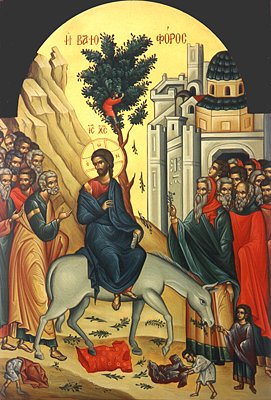
Palm Sunday, which is a week before Easter, commemorates the entrance of Jesus into the city of Jerusalem as children waved palm fronds. Palm Sunday marks the start of Holy Week.
This painting was created by George & Diana Voyajolu, Iconographers, Kamena Vourla, Greece. The Entry into Jerusalem. Byzantine style, contemporary artists.
Study Guide Assignments
- Read Matthew 21:1-17. This passage references the Old Testament three times. Copy down a quote in at least one of the verses (5, 13, or 16). Then read the Old Testament references, along with other adjacent verses in context: Isaiah 62:11-12, Isaiah 56:6-8, and Psalm 8:1-4.
- When Jesus entered the city of Jerusalem, the first place he went was the temple, where he “cleansed” it of all of the unholy things that were going on there. The temple is a symbol of our own hearts that Jesus wants to cleanse and transform into houses of prayer where he can dwell. Read Psalm 51:1-12 and think about it. Copy down the first verse.
- The hymn “All Glory, Laud and Honor” is about Jesus’ entry into Jerusalem. Read the words and listen to the music on-line at: All Glory, Laud and Honor. Read about the hymn and lyricist at Hymn Story and Theoldulph of Orleans. Write down when and where Theodulph lived and died.
- Click on each of these links to see a classic painting. For each one, tell me who the artist was, as well as about what year the painting was created. Entry Into Jerusalem and Christ's Entry Into Jerusalem. Then look at this stained glass: Triumphal Entry into Jerusalem on Palm Sunday and write at least one sentence about it. Be sure to read the descriptions!
- Choose one thing from today's assignments -- either a Scripture, the hymn, or a piece of artwork -- and write a response paragraph of at least five sentences that describe it and tell of your personal opinions about it.
Easter Assignment: The Last Supper and Trial

Theme: The Last Supper and the Trial
- The painting "The Last Supper" (above) is by Leonardo da Vinci. He painted it in 1498 on the refectory (dining room) wall in the Convent of Santa Maria delle Grazie in Milan, Italy. It is 15 feet high and 29 feet long! Click on the picture to enlarge it. Then, pay attention to the details in the picture and write down a few sentences about what story it is telling.
- All four gospels (Matthew, Mark, Luke, and John) include the story of the "Last Supper" but each one differs in how they present what happened. Read Matthew 26:17-35, Mark 14:12-31, and John 13:1-37. Write down at least one detail in each passage that wasn't in the others. What parts of the story do all of them include? What is one thing that you can apply in your own life from these passages?
- Read about Gethsemane and the trial at Matthew 26:36-75. Copy down the four section headings from the Scripture passage.
- The painting "Ecce Homo" is by Swiss artist, Antonio Ciseri (October 25, 1821 – March 8, 1891). "Ecce Homo" means "Behold the Man." The scene is Jesus' trial before Pontius Pilate, who is listening to the crowd. Please click on it to enlarge it. Write a two sentence response to it.

Easter Assignment: The Death of Christ
Theme: The Death of Christ
Study Guide Assignments
6. This tapestry below, "The Crucifixion" by Pieter Pannemaker, is found in the National Gallery of Art. You can click on it to enlarge it. How can you use your creative skills -- in visual arts, music, writing, or public speaking -- to communicate the message of Christ?

Study Guide Assignments
- Read Isaiah 53:1-12 and Psalm 22:1-18. These prophecies were written hundreds of years before Jesus was born, yet they foretell his death as the Messiah. Copy at least two verses from one of these passages. Write down at least two words from Isaiah 53 which are synonyms for the word sin.
- Click on When I Survey the Wondrous Cross. Read the lyrics, listen to the audio, and click on the verse reference. Copy down the Bible verse and the first stanza (four lines) of the hymn. Who is the lyricist (the man who wrote the words)? About how many centuries ago were the words written?
- Michelangelo sculpted the Pietà during the Renaissance era. ("Renaissance" is a French word which means rebirth.) Look at the sculpture carefully, and then write two sentences describing it. Then write another sentence telling who made it (including his last name), when it was created and where it is now. Then go to http://www.dictionary.com/ to find out what “pietà” means, and write the definition. What would it have been like to be Mary, holding Jesus' body after it was removed from the cross?
- Read Luke 23:26-56 and let it sink in. Imagine what it would have been like for you to be right there. Write several sentences as if you were making an entry in your journal the next day. You will continue this tomorrow in the assignment about the resurrection.
- Read the poem below and copy the first stanza.
"WHO OVERCAME EVIL BY GOOD"
by Mary Whitcomb Hess after a homily by Saint Amphilochius in the 4th Century
They stretch Him
On a Cross to die ---
Our Lord Who first
Stretched out the sky
Whose countenance
The cherubim
Dare not gaze on …
They spat on Him
And gave Him gall
To drink
Though He
Brings us wells
Of eternity.
He prays for them
“Father, forgive…”
For He was born
That all might live.
Round the sealed tomb
Of Him they’ve slain
They set a guard
In vain, in vain
Round Him
Creation can’t contain
Who dies for us
To rise again.
~*~*~
6. This tapestry below, "The Crucifixion" by Pieter Pannemaker, is found in the National Gallery of Art. You can click on it to enlarge it. How can you use your creative skills -- in visual arts, music, writing, or public speaking -- to communicate the message of Christ?
Easter Assignment: The Resurrection

Theme: The Resurrection
"The Resurrection of Christ" was painted by Russian Orthodox artist Mikhail Nesterov at end of the 1890's.
Study Guide Assignments
- Read the story of the resurrection and the ascension in Matthew 28 and Luke 24. Copy at least one verse from each passage.
- Continue the journal entry you started yesterday, writing as if you were there when these things happened.
- Listen to Christ the Lord is Risen Today! by Charles Wesley. What word appears at the end of each line, and what is an alternate spelling for this word?
- Read a blog post by Julia Knowles on her 3 month mission trip to Bolivia: *Behold, I am making all things new* :) Revelation 21 At the bottom, she talks about heaven. What famous preacher did she quote and when did he preach his sermon, "No Tears in Heaven"?
- Look at the painting, "Le Jour des Morts" (The Day of Death) by William Beaugereau in 1859. According to 1 Corinthians 15:35-58, what hope do we have because of the resurrection of Christ?


Subscribe to:
Posts (Atom)